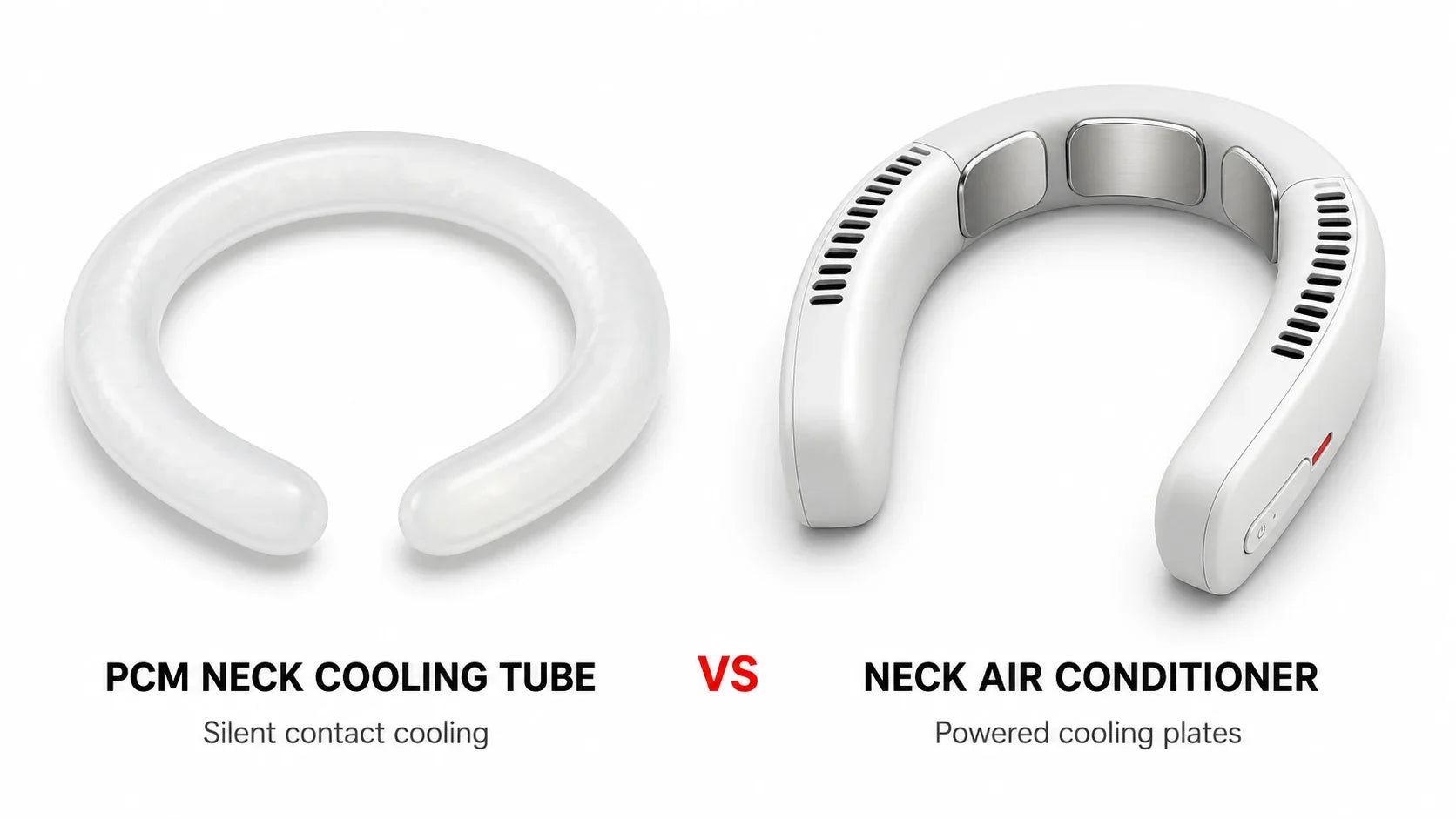
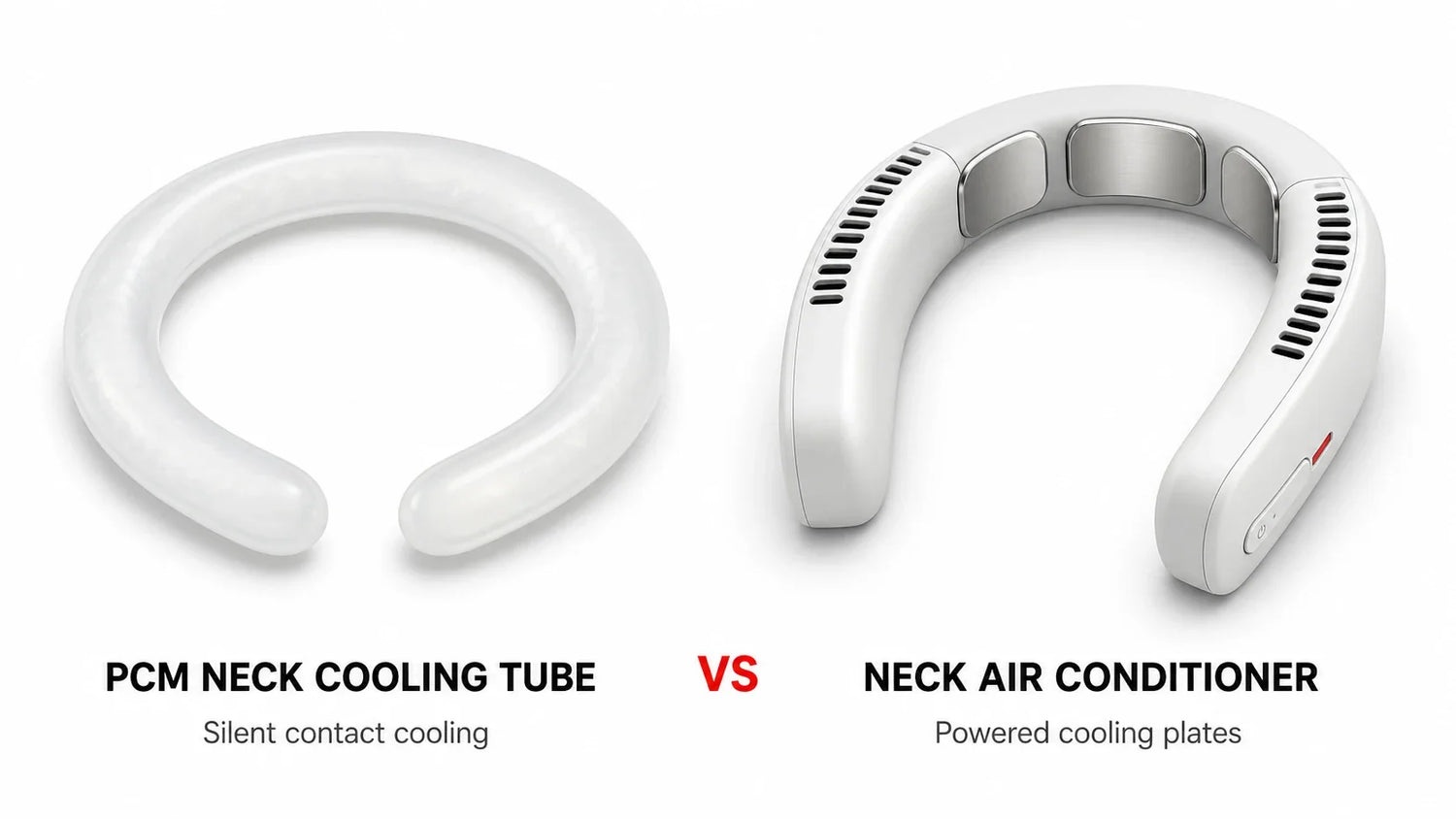
Jawaban singkat: Pilih tabung pendingin leher untuk sesi hening di antara waktu istirahat mendinginkan ulang, atau AC leher untuk pendinginan yang dapat disesuaikan selama masa pakai baterainya.
Sentuhan dingin pertama mudah dibandingkan. Yang terjadi kemudian lebih penting.
Bisakah Anda mendinginkan tabung lagi di tempat kerja? Apakah perangkat elektronik akan bertahan selama perjalanan Anda? Bisakah kerah Anda menjadi lembap?
Pertanyaan-pertanyaan itu lebih berguna daripada bertanya mana yang terasa paling dingin saat baru dibeli.
Perbedaan utama sekilas
Di sini, “AC leher” berarti perangkat dengan pelat pendingin bertenaga—bukan kipas leher yang hanya berfungsi sebagai kipas.
| Opsi | Yang Anda dapatkan | Yang Anda butuhkan untuk sesi berikutnya |
|---|---|---|
| Tabung pendingin leher PCM | Pendinginan kontak tanpa suara saat isiannya meleleh | Tempat yang cukup dingin untuk mengubahnya kembali menjadi padat |
| Bungkus pendingin leher es atau gel | Kontak dingin dari kantong yang telah didinginkan sebelumnya | Metode pendinginan atau pembekuan pada labelnya |
| Bungkus pendingin leher evaporatif | Pendinginan saat air menguap | Air bersih, plus udara yang memungkinkan penguapan |
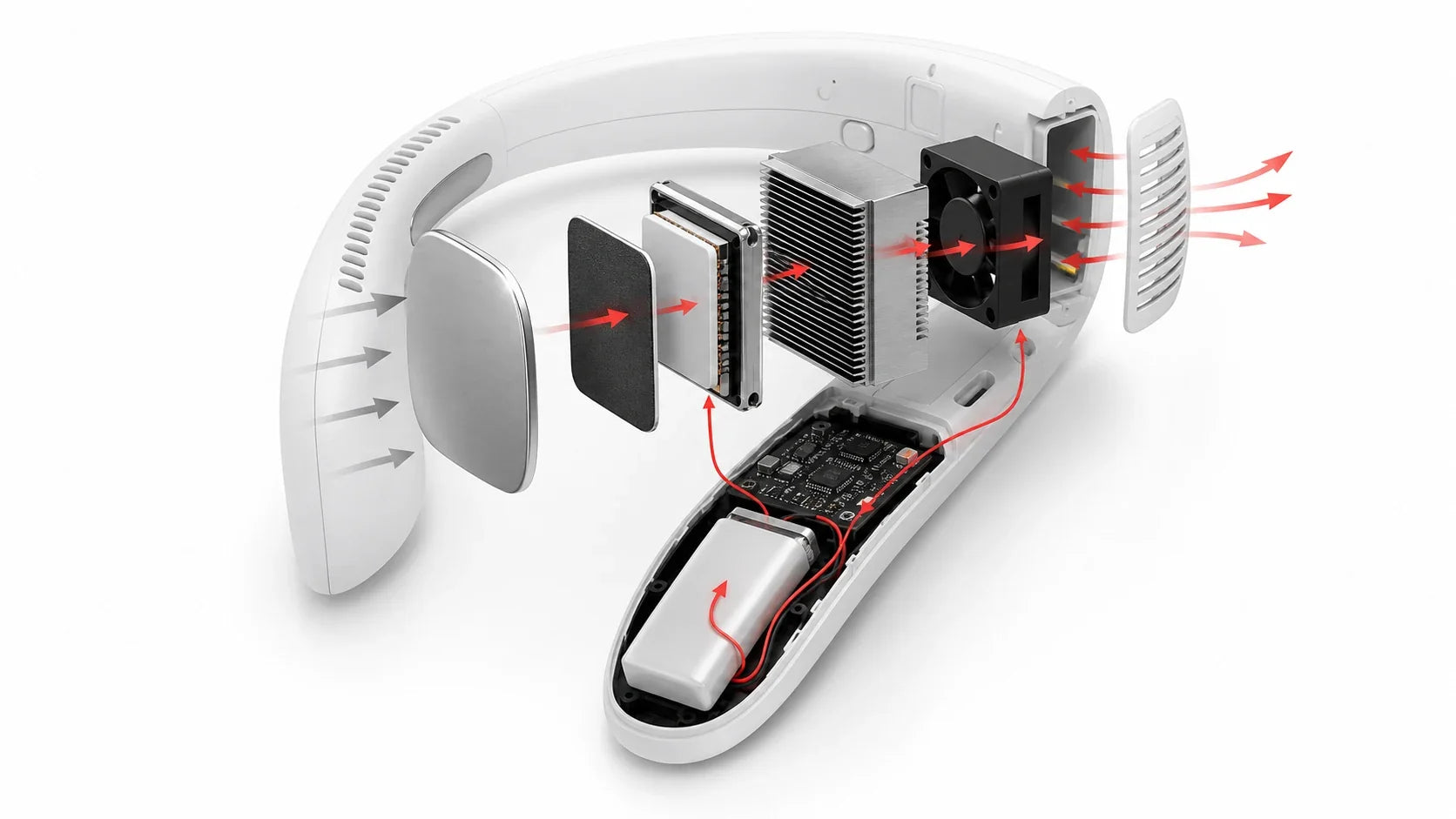
| AC leher | Pelat pendingin bertenaga; sering kali memiliki pengaturan yang dapat disesuaikan | Baterai terisi dan ventilasi pembuangan panas yang jelas |
Masih membandingkan semua kategori? Mulailah dengan panduan produk pendingin leher kami.
Tabung pendingin leher tidak selalu berupa kantong es
Banyak tabung pendingin leher mengandung material perubahan fase, atau PCM. Isiannya menyerap panas saat berubah dari padat menjadi cair.
Itu tidak harus membeku pada suhu yang sama dengan air.
Misalnya, SUO menggambarkan cincin 28°ICE-nya mengeras pada lingkungan sekitar 25–28°C atau lebih rendah. Itu adalah instruksi khusus produk, bukan aturan untuk setiap cincin pendingin. Informasi produk SUO.
Suhu yang tercetak pada ring menjelaskan spesifikasi material atau pengoperasiannya. Itu tidak menjanjikan bahwa kulit Anda akan tetap pada suhu tersebut.
Pendingin leher bertenaga listrik bekerja dengan cara berbeda. Modul termoelektriknya memindahkan panas dari sisi dingin ke sisi panas. Perangkat harus melepaskan panas tersebut ke sekitarnya. Panduan teknis Ferrotec.
Perbedaan praktisnya: tabung menyerap panas sampai perlu didinginkan ulang; perangkat elektronik terus memompa panas selama daya dan kondisi operasinya memungkinkan.
Mana yang bertahan dingin lebih lama?
Tidak ada pemenang yang jujur untuk seluruh kategori.
Waktu pendinginan efektif sebuah tabung tergantung pada isi, ukuran, kondisi awal, dan lingkungannya. Jalan kaki yang panas tidak sama dengan duduk di kantor.
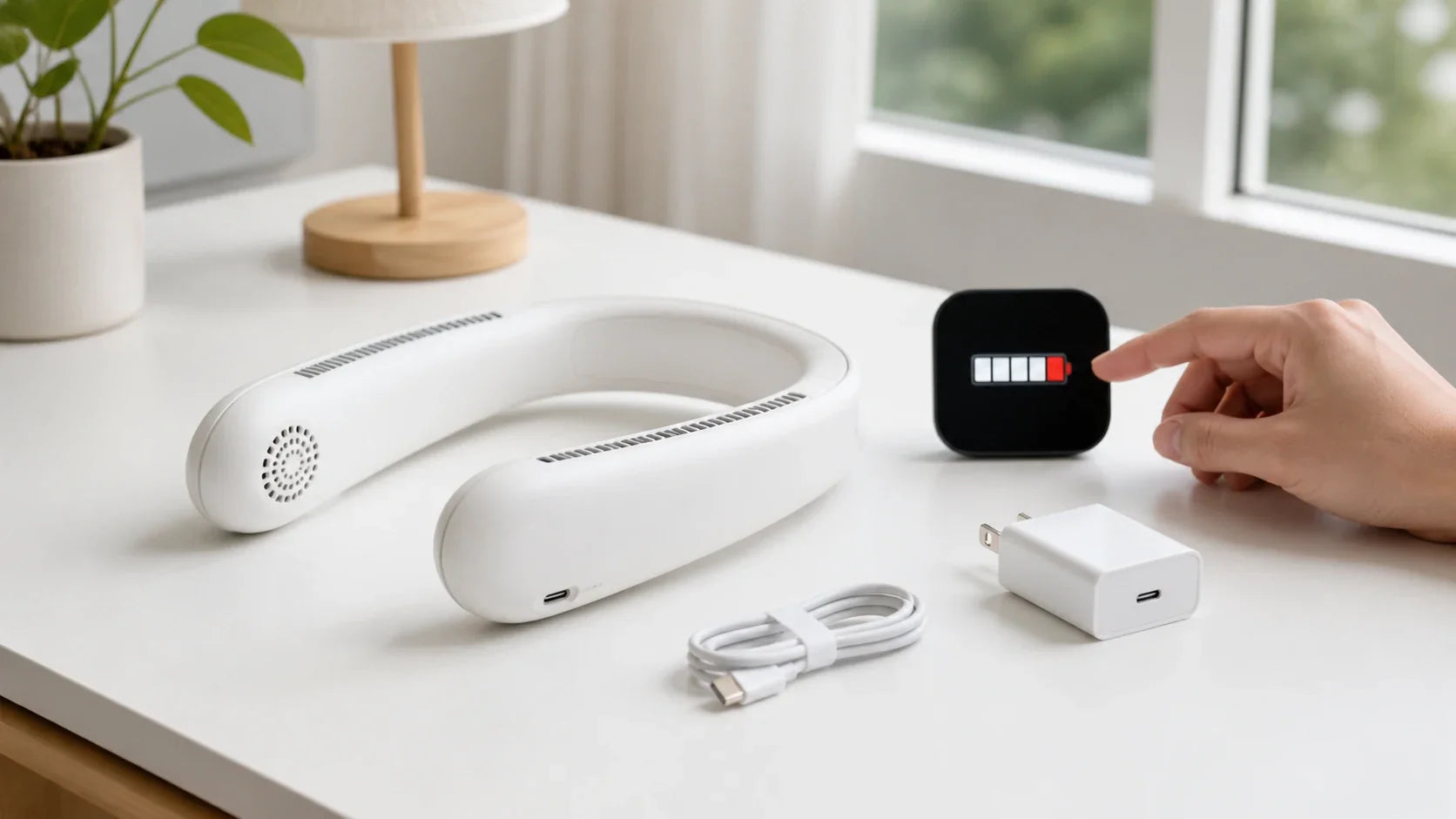
Untuk pendingin leher, periksa daya tahan dengan plat pendingin dinyalakan. Angka daya tahan terlama mungkin merujuk pada setelan kipas rendah tanpa pendinginan.
Ajukan dua pertanyaan sebelum membeli:
- Apakah akan memberikan pendinginan yang berguna untuk sesi saya yang sebenarnya?
- Berapa lama saya harus menunggu sebelum bisa menggunakannya lagi?
Sensasi dingin yang singkat dan kuat tidak menjawab kedua pertanyaan itu. Angka baterai tanpa mode juga tidak. Panduan masa pakai baterai dan pengisian daya kami menjelaskan apa yang perlu diperiksa.
Bisakah Anda menyiapkannya lagi di tempat Anda berada?

Ini sering menjadi faktor penentu.
Untuk tabung PCM: periksa suhu yang diperlukan dan waktu persiapan. Beberapa dapat diatur ulang di ruangan yang sejuk. Yang lain membutuhkan kondisi yang lebih dingin. Kantong hangat tidak akan memulihkan tabung yang sudah meleleh.
Untuk pendingin leher beku: pastikan apakah Anda memerlukan freezer atau lemari es. Jangan berasumsi semua kantong gel dapat disiapkan dengan cara yang sama.
Untuk pembungkus evaporatif: Anda memerlukan air bersih. Membasahi ulang itu mudah, tetapi pendinginan tetap bergantung pada penguapan.
Untuk pendingin leher: rencanakan pengisian daya di sekitar aktivitas harian Anda. Penggunaan saat mengisi daya tergantung pada model; jangan berasumsi power bank memungkinkan pemakaian terus-menerus.
Instruksi bisa sangat berbeda. Misalnya, kantong leher PCM Ergodyne 6283 mencantumkan air es, freezer, lemari es, dan dekat dengan AC sebagai opsi aktivasi. Metode itu tidak universal.
Bandingkan rutinitas lengkap—bukan hanya perangkatnya.
Bagaimana dengan kelembapan dan pakaian lembap?
Pembungkus leher pendingin evaporatif membutuhkan air untuk menguap. Udara lembap dan tenang membuatnya lebih sulit. Pendinginan PCM tidak memerlukan penguapan untuk menyerap panas.
Itu membuat PCM atau pendinginan kontak bertenaga layak dipertimbangkan ketika bungkus basah terasa lembap. Keduanya tidak membuat lingkungan lembap aman dengan sendirinya.
Juga, "tidak ada kain basah" tidak menjamin "tidak ada kelembapan." Permukaan di bawah titik embun udara sekitarnya dapat mengumpulkan kondensasi. Berhati-hatilah dengan klaim mutlak "tidak pernah menetes." Penjelasan titik embun dari National Weather Service.
Untuk detail lebih lanjut, lihat kipas, Peltier, dan pendinginan evaporatif dibandingkan.
Opsi mana yang cocok dengan harimu?
Meja kerja yang tenang atau perjalanan singkat
Tabung PCM layak dipertimbangkan ketika keheningan penting dan kamu dapat menyiapkannya sebelum setiap sesi. Pastikan tabung tetap nyaman di leher tanpa menekan.
Perjalanan berulang dengan akses pengisian daya
Pendingin udara leher mungkin lebih nyaman ketika kamu menginginkan pendinginan yang dapat disesuaikan tetapi tidak memiliki penyimpanan dingin. Periksa waktu operasional mode pendingin, kebisingan kipas, dan berat saat dipakai.
Istirahat di dekat lemari es atau freezer
Bungkus leher pendingin yang dapat digunakan kembali dapat cocok dengan rutinitas ini. Paket cadangan mungkin membantu di antara sesi—tetapi sertakan waktu persiapan dan berat bawaannya.
Hari tanpa pengisian daya atau penyimpanan dingin
Baik satu tabung maupun satu pengisian baterai tidak menjamin pendinginan sepanjang hari. Di udara kering, bungkus yang diaktifkan air mungkin lebih mudah disegarkan. Di udara lembap, rencanakan akses ke tempat yang lebih sejuk daripada mengandalkan bungkus.
Cara memilih tabung pendingin leher terbaik
Mulailah dengan kecocokan dan persiapan, bukan suhu terendah yang diiklankan.
- Ukuran: gunakan pengukuran leher dari merek, bukan hanya "ukuran dewasa."
- Berat: bandingkan keseluruhan yang dapat dikenakan, termasuk penutup atau paket apa pun.
- Instruksi reset: periksa suhu yang diperlukan dan waktu tunggu.
- Perawatan: cari instruksi pembersihan, penyimpanan, dan kebocoran yang jelas.
- Total biaya: sertakan tabung cadangan, penutup, atau perlengkapan penyimpanan dingin yang benar-benar kamu butuhkan.
Saat membaca ulasan tabung pendingin leher, lihat melampaui kesan pertama. Apakah suhu, kelembapan, dan aktivitas dijelaskan? Apakah kenyamanan diperiksa nanti dalam sesi?
Pemeriksaan pada 15, 30, 60, dan 90 menit dapat mengungkapkan bagaimana pengalaman berubah. Itu adalah titik pemeriksaan ulasan yang berguna, bukan durasi pendinginan yang dijanjikan.
Untuk alternatif elektronik, ajukan pertanyaan yang sama dan tambahkan mode operasi. Baca apa yang dapat—dan tidak dapat—ditunjukkan oleh tes pendinginan leher.
Pemeriksaan cepat dan keselamatan
Ikuti instruksi kontak kulit dan persiapan produk secara tepat. Gunakan penutup yang disediakan jika diperlukan. Jangan letakkan es langsung pada kulit.
Lepaskan pendingin jika menyebabkan nyeri, mati rasa, atau warna kulit yang tidak biasa. Ini bukan tanda pendinginan yang lebih baik. Panduan cedera akibat suhu dingin dari CDC.
Berhenti menggunakan tabung yang bocor. Ikuti instruksi pembersihannya; jangan menganggapnya bisa dicuci dengan mesin. Misalnya, Ergodyne menentukan pencucian tangan dan pengeringan untuk paket PCM-nya. Instruksi perawatan Ergodyne.
Tidak ada pendingin leher yang menggantikan air, istirahat, atau akses ke lingkungan yang lebih sejuk dalam panas berbahaya. Tindakan pencegahan panas dari NIOSH.
Pertanyaan yang sering diajukan
Apakah tabung pendingin leher tetap beku saat dipakai?
Tidak selamanya. PCM dimaksudkan untuk meleleh saat menyerap panas. Tabung yang lebih lembut tidak otomatis rusak, tetapi pendinginan yang berguna memudar seiring kapasitas pendinginan yang tersedia habis.
Bisakah saya membekukan kembali bungkus pendingin?
Jika dirancang untuk pembekuan berulang, ikuti instruksinya. Beberapa produk PCM hanya perlu didinginkan. Bungkus kain evaporatif adalah produk yang berbeda; jangan menganggapnya harus dimasukkan ke freezer.
Apakah tabung pendingin leher lebih baik untuk penggunaan sepanjang hari?
Hanya jika rutinitas pendinginan dan pengaturannya cocok dengan hari Anda. Memutar tabung yang sudah disiapkan dapat cocok untuk beberapa jadwal. Perangkat bertenaga dapat cocok untuk yang lain, asalkan waktu operasi mode pendinginannya cukup.
Intinya
Pilih tabung saat keheningan dan pemakaian sederhana paling penting—dan Anda bisa mendinginkannya lagi saat diperlukan.
Pilih AC leher saat pendinginan bertenaga yang dapat disesuaikan cocok dengan hari Anda—dan Anda menerima pengisian daya, bobot, dan kebisingan kipas.
Siap membandingkan opsi elektronik? Lihat panduan pembelian AC leher.