
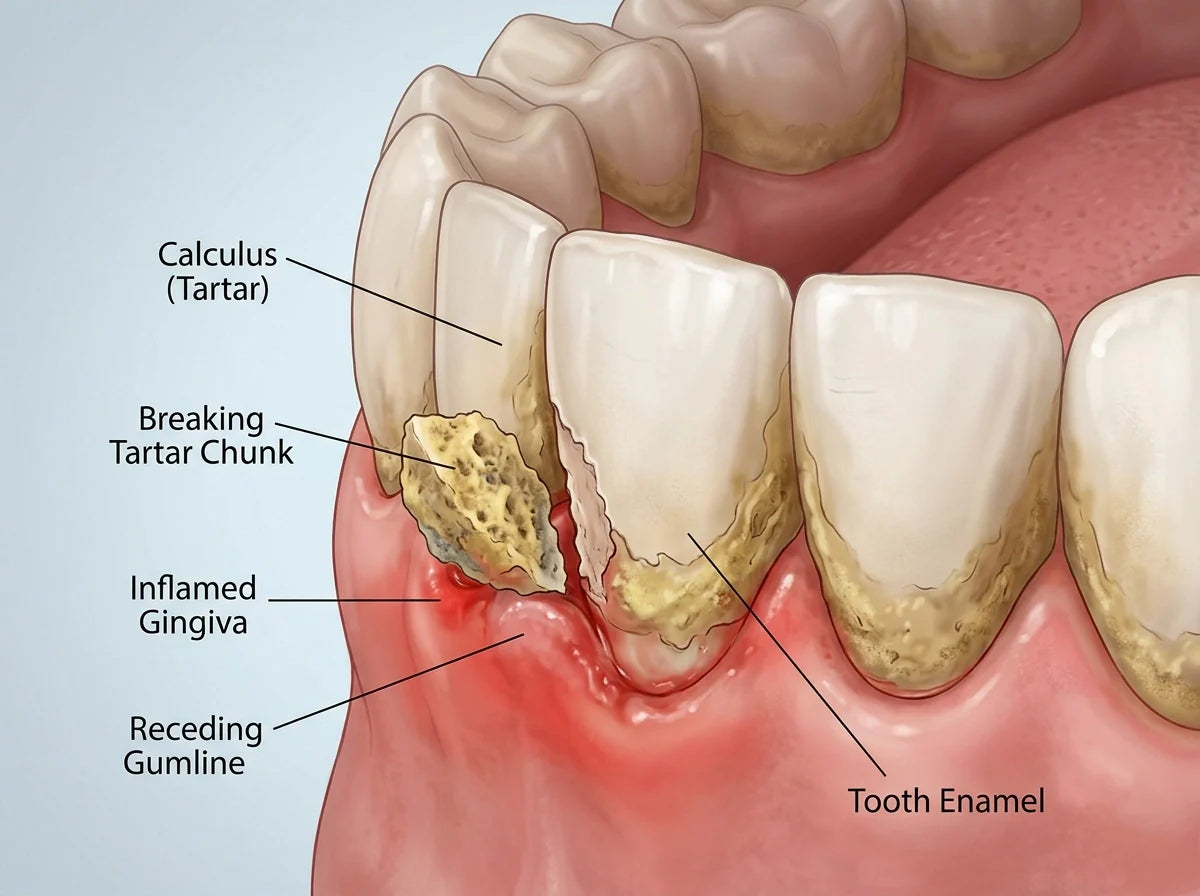
TL;DR: Tartar breaking off is almost always a warning sign, not a positive event. A dislodged chunk of tartar (dental calculus) usually leaves behind sharp edges, exposed sensitive roots, or underlying decay. While a tiny, harmless flake can sometimes pop off, the safe bet is to treat any lost tartar as a reason to see a dentist within a few days.

It’s a strange, often jarring moment: you feel something hard and gritty detach from a tooth while eating, flossing, or just running your tongue across your gums. For a second, you might even think, “Good — that ugly buildup is gone.” But that flash of relief is misplaced. A piece of dental tartar (calculus) that breaks off on its own is rarely a reason to celebrate. It’s a clear signal that something was already wrong beneath the surface — and that professional care is overdue.
Why Tartar Doesn’t Just Fall Off Healthy Teeth
Dental tartar isn’t a loose scab or a bit of dirt that can shake free. It’s calcified plaque — a mineralized biofilm that fuses tightly to the tooth’s surface. While dental plaque is a soft, sticky film you can brush away, once it hardens into tartar, it becomes a cement-like deposit that bonds chemically to enamel. This attachment is so strong that tartar cannot be removed with regular brushing or flossing; only a dental professional can safely scale it off.
So when a piece breaks loose without professional tools, something has to give. Usually, the tartar has been growing so thick that a mechanical force (like a hard chip or aggressive floss) fractures it, or the tooth structure underneath has already been weakened by decay or bone loss from periodontitis. In either case, the event points to a pre-existing problem, not a sudden improvement.
Because tartar starts forming within hours of missed brushing and can mineralize fully in a matter of days, prevention is everything. Using an electric toothbrush can help you achieve a more thorough clean every day, reducing the plaque that eventually hardens into calculus.
Good Sign or Red Flag? A Rare Exception
There is one scenario where a tiny, superficial flake of tartar might chip off during flossing without causing harm. This can happen when the deposit sits just at the gumline, hasn’t anchored deeply into the enamel, and detaches cleanly — leaving behind a smooth surface and no pain. However, this is the exception, not the rule.
Most of the time, tartar that breaks off leaves behind: - Sharp edges that can cut your tongue or cheek - Exposed dentin or root surfaces that are exquisitely sensitive to cold, heat, and pressure - A rough, crater-like texture that traps plaque even more aggressively - Bleeding or ongoing tenderness — signs of active gingivitis or deeper infection
A landmark study using endoscopic visualization found that 70% of inflamed gum pockets were directly associated with visible calculus deposits, not just bacteria alone, suggesting calculus itself drives inflammation. If the area where the tartar dislodged is red, swollen, or bleeding, you should assume the underlying tissue is not healthy.
How to tell if it was tartar or a broken tooth: A tartar fragment is usually yellowish or brownish, may crumble when pressed, and feels slightly softer than tooth enamel. A tooth fragment is hard, shiny, white or off-white, and may fit back onto the tooth like a puzzle piece. If you’re uncertain, treat it as a dental emergency.
Hidden Damage You Don’t See Yet
The piece that broke off is often just the tip of the iceberg. Subgingival tartar — the calculus that builds below the gumline — can create deep pockets where bacteria thrive, eating away at the ligament and bone that hold the tooth in place. When a visible chunk snaps free, it can be a warning that the supporting structures are already compromised.

Research increasingly shows that calculus is more than a passive plaque trap. A 2022 narrative review noted that even sterile calculus particles can cause cell death in oral epithelial cells, potentially breaking down the protective barrier of the gum pocket. This means the rough, fractured surface left after a piece breaks off isn’t just annoying — it actively promotes further tissue destruction. If periodontitis has already set in, the exposed root surface becomes a magnet for re-accumulation, accelerating the disease.
Without intervention, the remaining subgingival tartar can lead to: - Continued gum recession - Alveolar bone loss and tooth mobility - Infection reaching the pulp (requiring root canal treatment) - Eventual tooth loss
The good news: catching it now, when a chunk has just broken off, gives you a head start. It’s an early alarm that gets you into the dental chair before irreversible damage occurs.
What to Do Right Now (And What Not to Do)
Your immediate actions matter. Here’s how to handle the situation safely:
- Gently rinse with warm salt water (half a teaspoon of salt in a cup of water) to keep the area clean.
- Avoid probing the spot with your tongue, a toothpick, or any tool. Poking can introduce bacteria deeper into the gum pocket or fracture remaining tartar further.
- Never try to pry off more tartar with your fingernail, a dental pick, or any household instrument. DIY tartar removal can chip healthy enamel, cause deep cuts, and push bacteria into the bloodstream.
- Cover sharp edges with sugar-free dental wax (available at most pharmacies) to protect your tongue and cheek while you wait for your appointment.
- Book a dental visit within a few days. The jagged surface left behind is a perfect home for new dental plaque, so prompt professional smoothing is essential.
While no toothbrush can remove established calculus, switching to a sonic electric toothbrush can clean your teeth gently yet effectively, helping you avoid the rough scrubbing that might dislodge more tartar or irritate already inflamed gums.
How a Dentist Will Safely Solve This
If the thought of a dental visit makes you nervous, rest assured that dealing with broken tartar is a routine, well-understood procedure. The process is gentle, predictable, and far more comfortable than dealing with the consequences of neglect.
During your appointment, the dentist or hygienist will: - Examine the area with a periodontal probe and likely take an X-ray to assess the full extent of tartar below the gumline and check for bone loss - Remove the remaining supragingival and subgingival calculus with ultrasonic scalers and hand instruments — this is the professional dental cleaning (scaling) that restores a smooth, clean tooth surface - Treat any cavities or gum pockets that may have been hidden under the tartar - Polish the tooth to slow future plaque accumulation
According to clinical practice guidelines, scaling and root planing (SRP) is the gold standard initial therapy for periodontitis, effectively controlling inflammation and stopping disease progression. When you address the issue early, the treatment is often quick, minimally invasive, and covered by most dental insurance plans.
Far from being a terrifying event, that broken piece of tartar was your tooth’s way of alerting you — before a minor problem turned into a major one. By taking it seriously now, you’re choosing to protect your smile with a fast, professional fix that prevents pain, infection, and tooth loss down the road.





Leave a comment
Situs ini dilindungi oleh hCaptcha dan berlaku Kebijakan Privasi serta Ketentuan Layanan hCaptcha.